How to lend to strangers without collateral
Over two years, 922,307 strangers took 1.49 million loans through Credit, with no collateral. This is what we learned.


How do you lend to a stranger without collateral? If they don't repay, there's nothing to fall back on. If they do, they may only be earning your trust for a bigger loan they'll never repay.
Onchain, any borrower can be that stranger: a new wallet is free to create and says nothing about who owns it, so a borrower who walks away can come back with a new one. From December 2024 to November 2026, we ran Credit, a mini app inside World App (now World Money), to find out whether strangers like these would repay small loans without collateral. In all, 922,307 of them took 1,491,654 loans through it.
Credit had two rules. Each person could have only one account, so a borrower who walked away couldn't simply come back as someone new. And a limit could grow only by the interest a borrower had already paid, so running off with a bigger loan never paid more than defaulting on the first. Repayment rose with every loan: by the tenth, nearly nine in ten were repaid.
Starting borrowers small and raising their limits as they repay is not new: mobile lenders have done it for more than a decade. But they know who their borrowers are. Credit did the same with strangers, never asking who they were.
What Credit was
To borrow, people verified with World ID, which gave each person a pseudonym: one account, created once, that told Credit nothing about who they were. Loans arrived in their wallet as USDC within seconds and were due back with interest by a set date. If one went unpaid, Credit could collect it from that same wallet, where World's monthly grant of a few WLD arrived, so first loans were kept to a few dollars, a median of about $2. Only one loan could be open at a time, and repaying on time raised the limit for the next one, as high as $1,000.
Many borrowers put it to work. "I sell fruit and vegetables from home, and when I'm short of money to restock, I turn to Credit," one wrote in a 2025 survey of Credit's users. Asked in a March 2026 survey of 15,489 users what they would do with a higher limit, four in ten mentioned a business or investing. In the 2025 survey, three in four said they couldn't get credit from a bank.
The money came from 3,223 onchain liquidity providers, or LPs, who over time deposited $7.3 million in USDC into a pool on World Chain. Prices weren't set by Credit: rates rose as more of the pool's money was lent out, to draw in more deposits, and fell when money sat idle, to draw in more borrowers. Explore the data on Credit's analytics dashboard.
Two problems
The first problem, telling who will repay when anyone can come back with a new wallet, is an old one in economics. George Akerlof showed in 1970 that when buyers can't tell good from bad, the bad can drive out the good until a market collapses. He made the same point about credit: when lenders can't tell who will repay, the honest pay for the cheats. Eric Friedman and Paul Resnick found in 2001 that cheap pseudonyms create exactly this problem: when anyone can misbehave and start over under a new name, every newcomer might be a cheat in disguise.
One way out is biometric recognition, and economists have measured what it is worth. Until 2017, Malawi had no national ID system, so a borrower who defaulted could come back as a new applicant. In a field experiment published in 2012, Xavier Giné, Jessica Goldberg and Dean Yang had a Malawian lender fingerprint randomly chosen applicants so it could recognize past defaulters. Among the borrowers most likely to default, those fingerprinted took smaller loans and repaid substantially more.
World ID works much like those fingerprints, with an iris scan instead, and comes close to the way out Friedman and Resnick proposed: a pseudonym that is free but can't be replaced. That let Credit recognize past defaulters without learning anyone's name and let small first loans work as cheap tests: 99% were $5 or less, so finding out who would repay cost at most a few dollars a borrower.
The second problem is the long con, in which a borrower repays only to earn a bigger loan they'll never repay. Credit's defense was to let a limit grow only by the interest the borrower had already paid, so the most anyone could walk away with was their initial limit, however many loans they repaid and however fast. In a 2026 paper, we show that this cap makes the long con no more profitable than defaulting on the first loan.
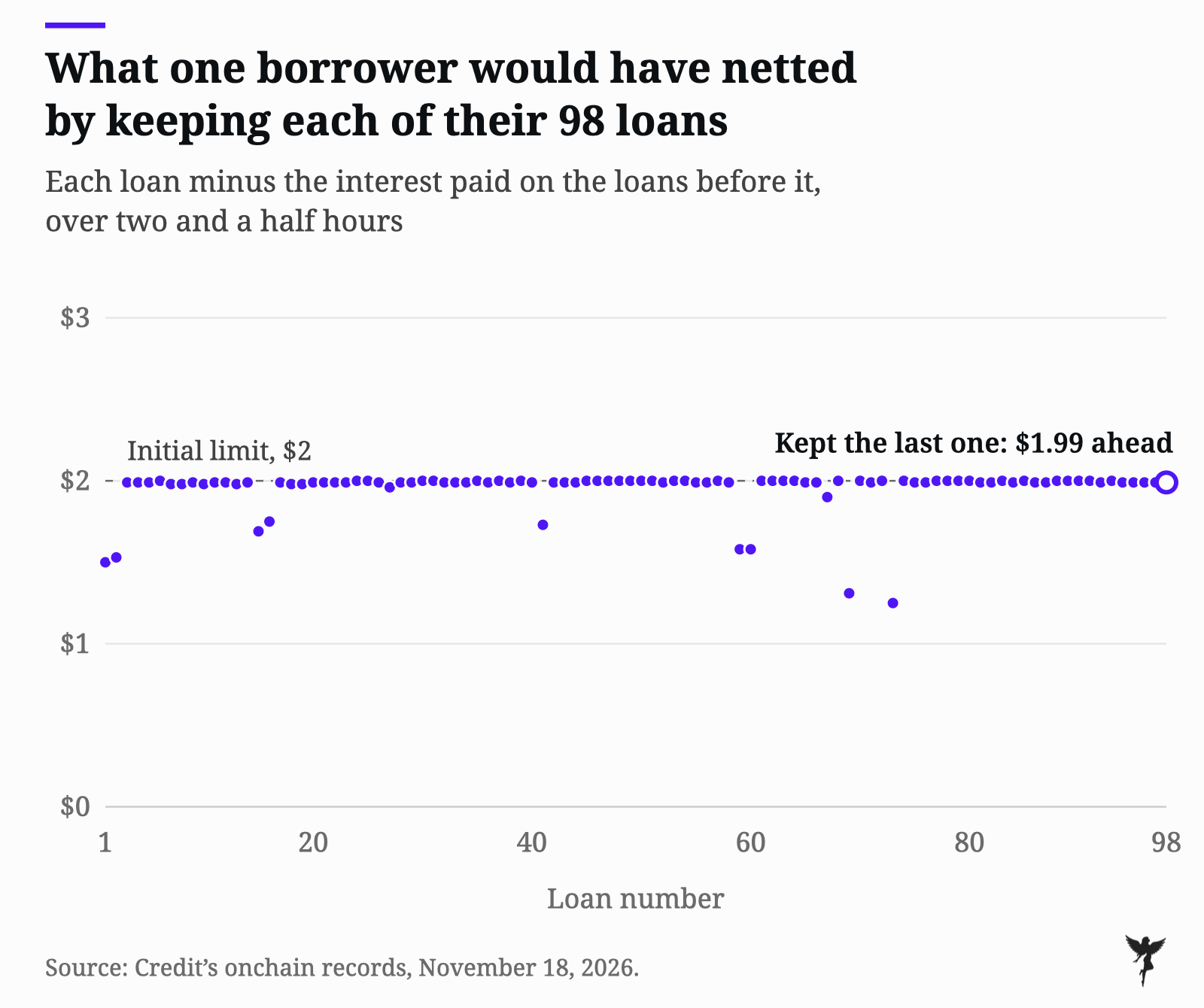
Some borrowers tried it anyway. One took 98 loans in two and a half hours, repaying almost every one within a minute, and grew their loans from $1.50 to $155.02. Then they kept the last one. But across their 97 repaid loans they had already paid $153.03 in interest, so running off left them $1.99 ahead, just under their $2 initial limit, the most they could have netted at any point. Across all 922,307 borrowers, 99.87% came out no more than $5 ahead, and none more than $11.26.
What the loans showed
People repay credit they have earned, and they come back for more. "As I keep paying, my credit goes up," another borrower wrote in the 2025 survey. For some it went up a long way: the largest loans reached hundreds of dollars, and one borrower whose first loan was $5.27 borrowed the $1,000 maximum just over a year later, on their 70th loan, and repaid it. Over the two years, 569,347 loans were repeat loans, and 3,210 people kept borrowing for a year or more.
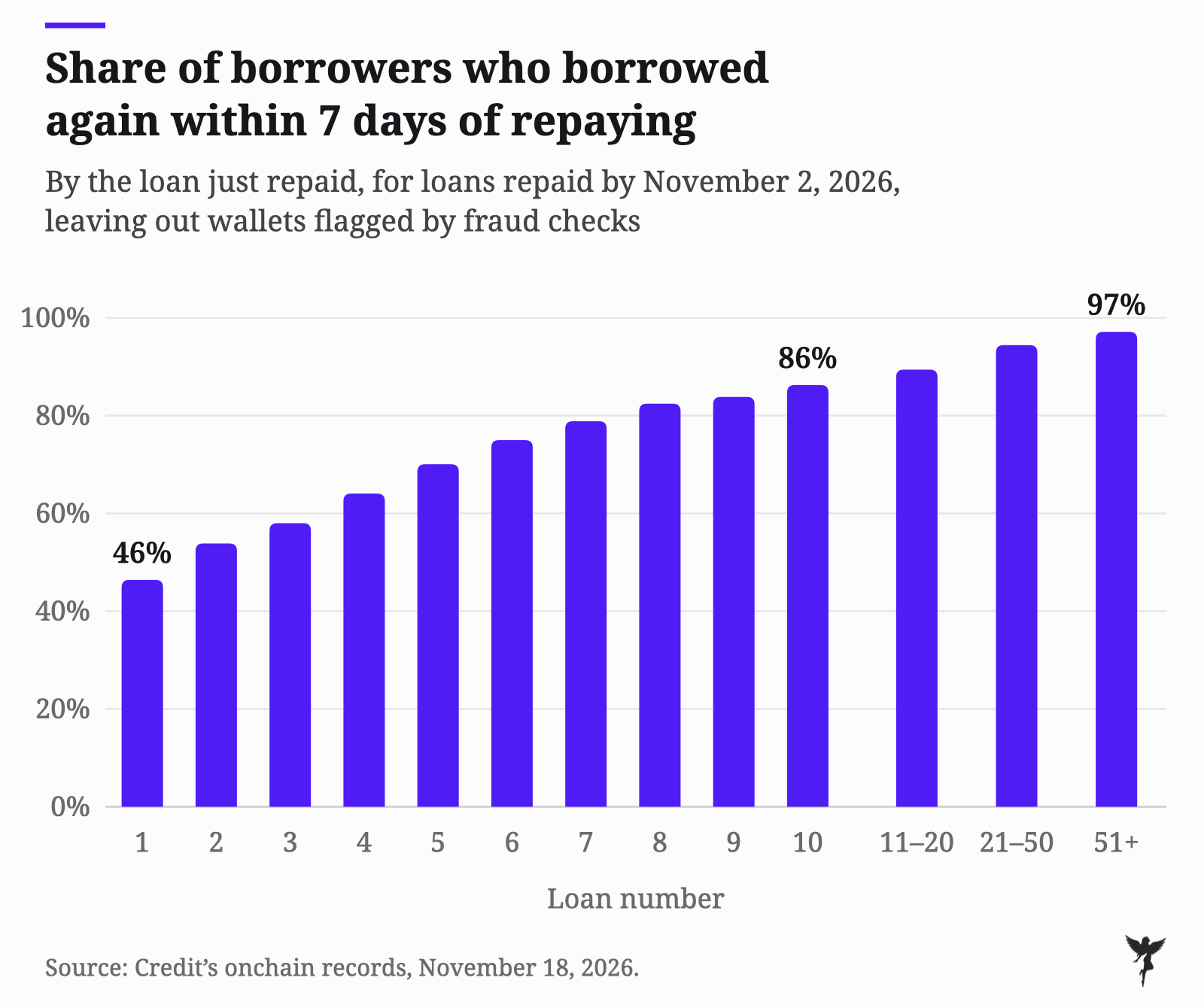
Within a week of repaying a first loan, 46% of borrowers took a second, and among those who had repaid on time, 74%. After a tenth loan, 86% took another, and past the fiftieth, 97%, at prices the pool set.
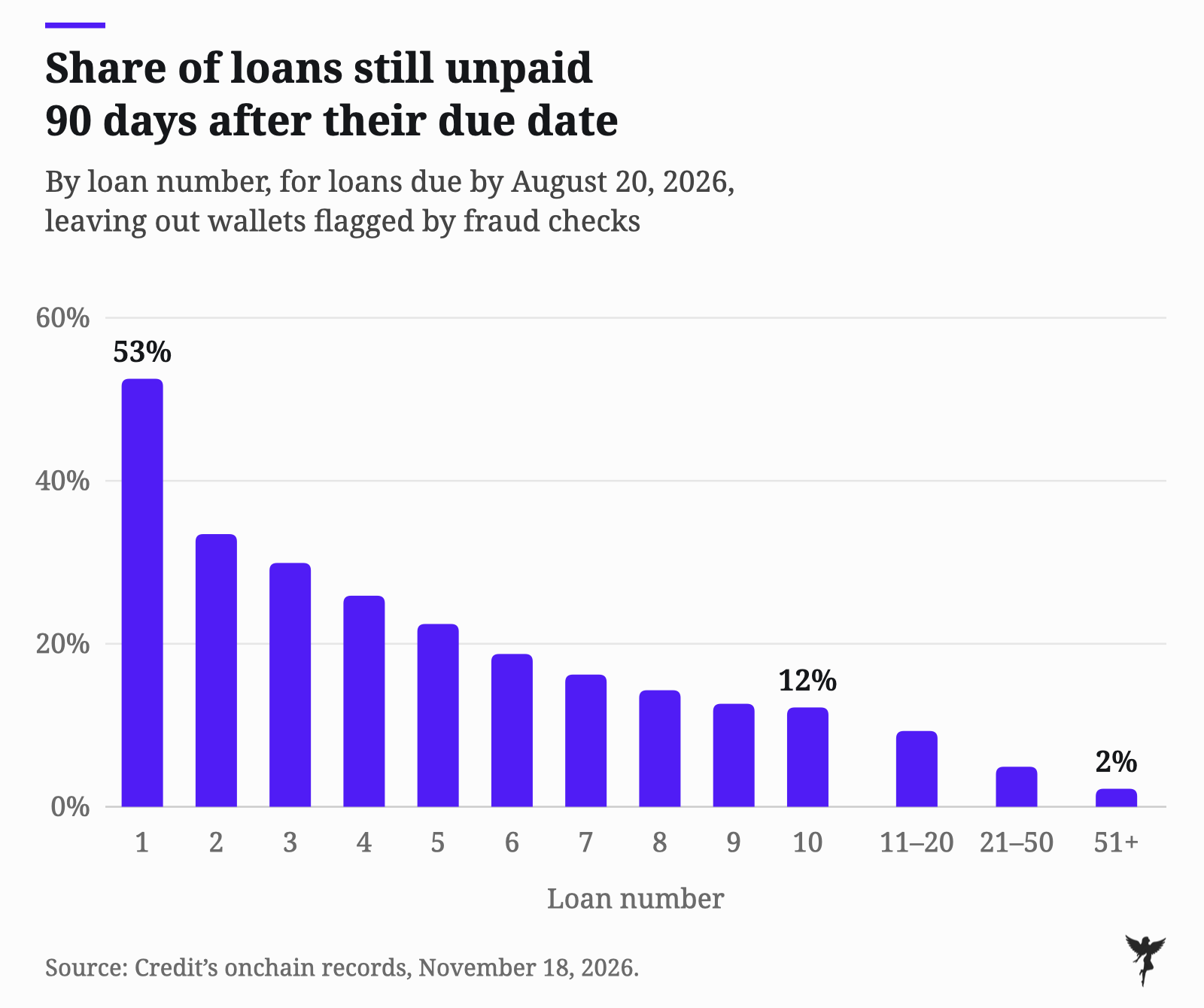
Defaults fell just as steadily. Of first loans, 53% were still unpaid 90 days after they were due; of second loans, 33%; of tenth loans, 12%; and of loans past the fiftieth, most of them due within days, 2%. Collection did most of the work at first and little later: it brought in 81% of what was repaid on first loans, 16% on tenth loans and 4% on loans past the fiftieth.
Picture two kinds of borrowers: those who mean to repay and those who don't. First loans mix both. Of borrowers whose first loan had to be collected, half ever borrowed again; of those who repaid their own, 84% did. Even if every loan were the same size, each round would filter out more of the second kind than the first, so the borrowers who remain are more and more the kind who repay. Growing limits add a second force: each repayment raises what borrowers stand to lose, since missing a payment would end a growing line of credit. Both likely pushed repayment up with every loan. Instead of guessing who would repay, Credit let borrowers show it.
Where it leads
Credit had an answer for the question this post opened with: lend a little, and let them earn the rest. For that, you don't need to know who borrowers are, only that each of them has just one account. In November 2026 we wound Credit down to take on a bigger question: how far that credit can reach.
Much farther, we think, because strangers like Credit's borrowers are everywhere. Close to a million of them found Credit without any marketing, from the Philippines to Kenya to Argentina. In low- and middle-income countries alone, four billion adults now carry a phone.
We're building Casia as a standalone app to reach them directly. A government ID keeps each person to one account, and a global pool of USDC funds the loans. Funds convert automatically between USDC and local currency over local payment rails, so borrowers deal only in their own currency. Our goal is to make this kind of borrowing available to anyone with a phone.
Thank you to the 922,307 people who borrowed through Credit, to the LPs who funded their loans, to World, whose app and World ID made Credit possible, and to our investors, who backed us early.
If you'd like to help build Casia, we'd love to hear from you at hello@divine.inc.
About the numbers
Loan figures come from Credit's onchain records as of November 18, 2026; totals and deposits come from credit.cash/analytics, which will stay online. A loan counts as paid whether the borrower paid it or Credit collected it from their wallet, and as defaulted if it was still unpaid 90 days after its due date, among loans due by August 20, 2026. Reborrow rates count borrowing again within 7 days of repaying, among loans repaid by November 2. Loan counts include every borrower; default, reborrow and collection figures leave out wallets that World's fraud checks had flagged. Survey figures come from Credit's user surveys of March 2026 (15,489 responses in English, Spanish, Indonesian and Thai) and 2025 (2,446 responses in Spanish); written answers were counted by keyword, and the quotes, both from the 2025 survey, are translated from Spanish. The count of adults with a phone comes from the World Bank's Global Findex 2025.
References
George A. Akerlof (1970). "The Market for 'Lemons': Quality Uncertainty and the Market Mechanism". Quarterly Journal of Economics 84 (3): 488–500.
Diego Estevez (2026). "Unsecured Lending via Delegated Underwriting". arXiv 2605.03307.
Eric J. Friedman and Paul Resnick (2001). "The Social Cost of Cheap Pseudonyms". Journal of Economics & Management Strategy 10 (2): 173–199.
Xavier Giné, Jessica Goldberg and Dean Yang (2012). "Credit Market Consequences of Improved Personal Identification: Field Experimental Evidence from Malawi". American Economic Review 102 (6): 2923–54.
World Bank (2025). "The Global Findex Database 2025: Connectivity and Financial Inclusion in the Digital Economy". Washington, DC: World Bank.